My bookseller friend who’s been experimenting with AI, the one I mentioned in Part One of this essay, is Scott Brown, who sells books out of Portland, Oregon as Downtown Brown Books – he’s a smart guy, a fine writer and one of the sharpest analysts of the book trade I know. He publishes on Substack at Dispatches from the Rare Book Trade and I encourage you to give it a look (I realize I’ve been burying links all over the place in my posts, for which apologies. I’ll soon be putting together a page of links to blogs and other things I like). You can (and should) read Scott’s full article documenting his cataloguing experiments with A.I. here, but let me share with you his concluding paragraph:
Conclusions: AI chatbots can already competently catalog books based on photographs with no special training. Chatbots are lousy at pricing. Most booksellers favor long descriptions; I don’t. Rare book dealers will rely heavily on AI chatbots for cataloging in the future, leaving mainly the least enjoyable part of my job, taking photos and packing and shipping to the humans. With a bit of judicious editing, almost no one will be able to detect that AI wrote a book description, except perhaps another AI cataloging bot.
I agree with almost everything in this paragraph except the thesis sentence. It’s absolutely true that the AI samples Scott’s experiment produced are (judicious editing or not) almost indistinguishable from ones written by humans – and in fact are vastly more engaging than descriptions many on-line booksellers produce (I’m particularly fascinated by this phenomenon, which strikes me as odd, and I’ll explore it in a future installment). Chatbots are definitely lousy at pricing – a trait they share with many booksellers. That “rare book dealers will rely heavily on AI chatbots for cataloging in the future” is inarguable, unless one wishes to quibble over whether the future is already upon us (based on my observations of the on-line marketplace and conversations with new booksellers at the Antiquarian Book Seminar, I’d say the future arrived about two-and-a-half years ago). Scott and I probably disagree about what is the ideal length for a rare book description, but I think we’d definitely agree that it should be no longer than it needs to be to perform its function – that is, to sell the book. Exactly how long that is depends of course upon the book, as well as the cataloguer’s taste and judgment, which are typically fashioned as a response to who their customers are and what they want.
Before going further I should make clear that I don’t interpret Scott’s statement that “AI chatbots can already competently catalog books based on photographs with no special training” as an endorsement of AI as a cataloguing tool – only as an acknowledgment of a technological reality that’s already upon us. Scott’s personal attitudes towards AI and its applications to the book trade are only hinted at in his Substack pieces – he’s much better than I when it comes to letting readers draw their own conclusions. If I had to venture a guess, though, it would be that Scott and I aren’t far apart in our skepticism of AI’s present utility to the cataloguer. Where we might differ is in our level of fascination for AI‘s potential. In the context we’re discussing here – the writing of catalog descriptions with minimal human input – I think it has none. And I’ll spend the next couple of installments of this essay explaining why.
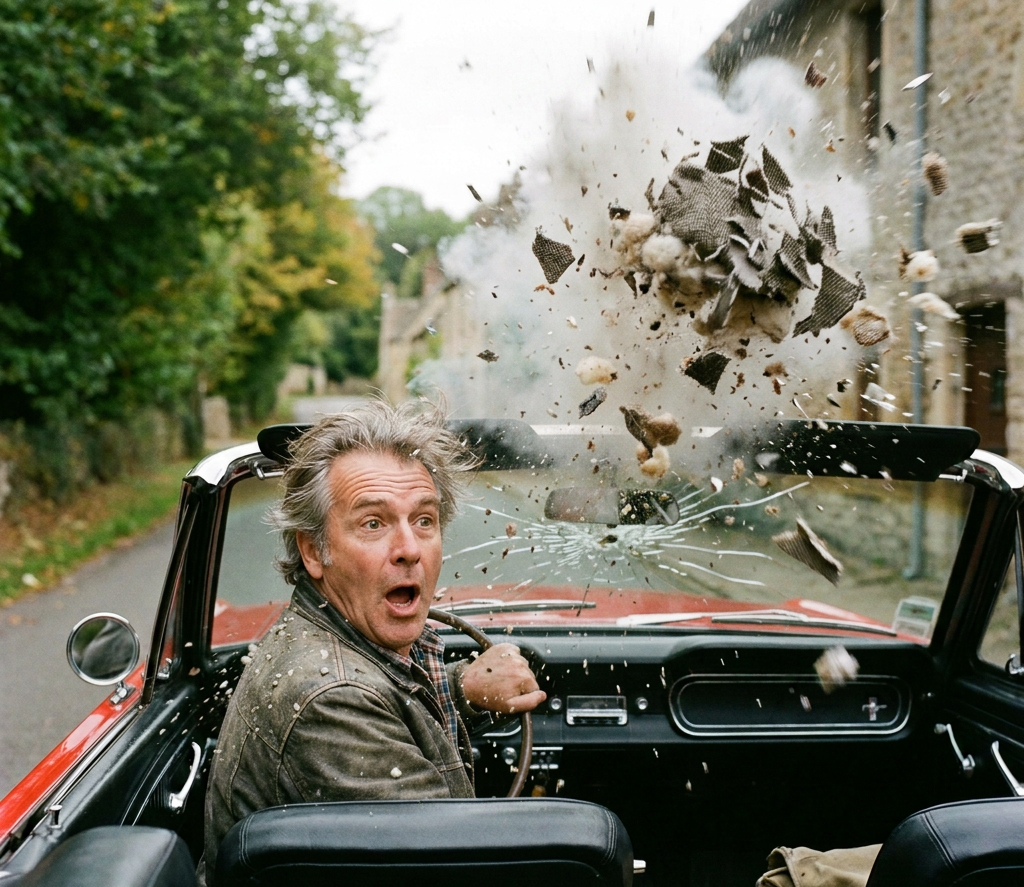
I suspect that readers who’ve been following along will have a decent idea of the direction I’m headed in from here. I hinted at it in Part One: a description based upon a two-dimensional image is not a description of the thing – it’s a description of something else entirely, a meta-thing. To the degree that it appears to be an actual description of the thing, it is dangerous: an Exploding Hat.
But I don’t think this goes far enough towards explaining what I believe to be the First Rule of book cataloguing, and that’s this:
A book description must begin from the examination of the book as a physical object, occupying a specific location in time and space.
All else flows from this. The rule holds true from both a practical perspective – as in, I wouldn’t buy a 1965 Mustang from someone based exclusively on their description of the car’s “mythical place in American automotive culture” (if that sounds like something Chat GPT might write, well, that’s because Chat GPT wrote it) – and a philosophical one: the instantiation of the book you are holding in your hand is different in material ways from every other instantiation of the book, and is in fact different from itself at other points in its history – even if only by virtue of the fact that you, not someone else, are the one holding it; and it’s your sensory consciousness, not someone else’s, that’s interpreting it.
The first question to be asked about any physical thing we want to describe using language is always: “What is it?” The only way to answer that question adequately is to examine our object with whatever senses we possess, and to state as precisely as we can what it is we see, feel, hear, or smell. If it’s a ’65 Pony, we begin by lifting the hood – almost no one would argue with this. Why then should it feel anti-intuitive that the first step in describing a book is…to open the book?
Is it that a book’s mechanical complexity is less obvious, or less interesting, to the casual observer than an automobile’s? There’s probably something to that, but I would point out that rare book cataloguers aren’t (or shouldn’t be) casual observers; and that, when we allow ourselves the time to not be casual, a book becomes a magically complex thing, filled with evidence of its own history, riddled with potential points of failure. Again, we can approach this from an earthly perspective: to sell a car without divulging that its brake cables are leaky is tantamount to a crime, one that differs only in degree from our failure to disclose that a book we’re selling has three leaves missing from the second gathering. Or we can take the celestial view: our failure to engage our senses is an abrogation of our responsibility to history and a surrender of one of the key pleasures available to us as stewards of the book: the chance of discovery – and even enlightenment.
Or does this failure to open up the book and look at it have to do with something else entirely – the simple, straightforward need to be profitable? I’m in deep sympathy here. As I never tire of pointing out to colleagues, there’s little point and no future in trying to sell books for a living if we’re not compelled by the pursuit of profit. No matter how much we love our work, without profit we’ll eventually run out of money or patience – depending on which of these is in shorter supply. Because of this, there’s always an imperative for booksellers to analyze our work routines for efficiency: if we’re smart, we regard every “touch” of the book as an overhead expense, and we’re constantly looking for ways to reduce the number of times we put our hands on any individual item in our inventory. But it shouldn’t follow that, in order to do our work more profitably, we simply refuse to do our work. Bookselling, especially antiquarian bookselling, is by its nature a high-touch undertaking. It can only be streamlined to a degree. And the aspect of our work least accommodating to shortcuts is our physical interaction with the book.